

Industrial measurement processes often contain a surprising amount of manual work. Tasks that seem straightforward on paper—such as collecting data around a large static asset at a defined distance – can become challenging when accuracy, repeatability, and efficiency are required.
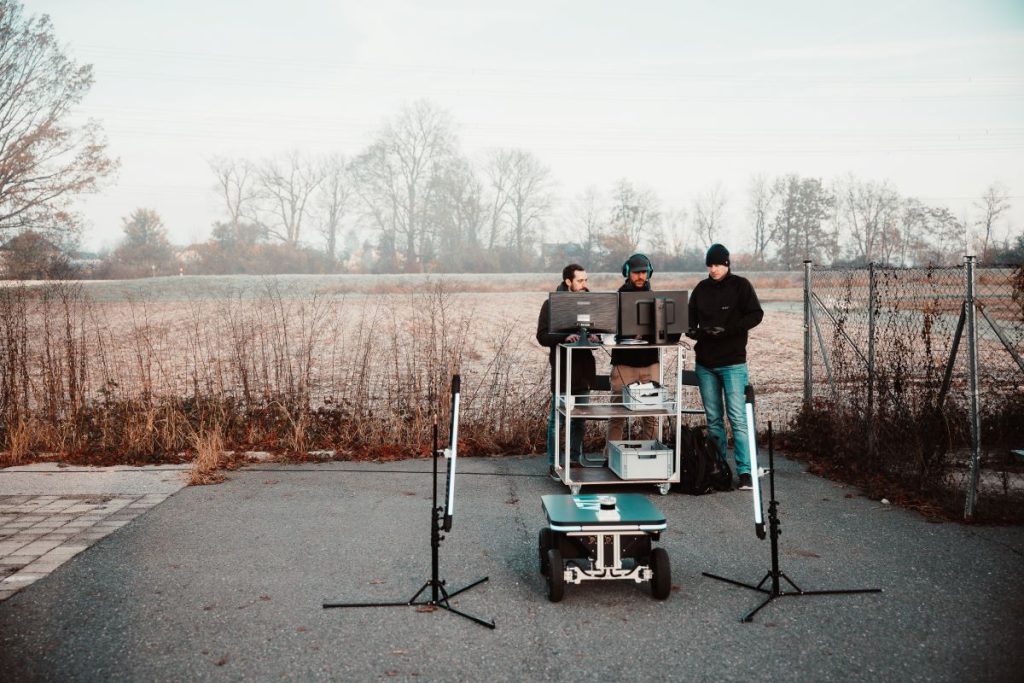
Recently, ARTI worked with a customer to evaluate whether such a workflow could be automated using autonomous mobile robotics. Rather than focusing on a specific industry application, the project explored a more general challenge: enabling a robot to autonomously perform measurements around a large object while maintaining a consistent offset distance and requiring minimal operator input.
The project provided an excellent opportunity to demonstrate not only the flexibility of ARTI’s navigation technology, but also how close collaboration between customer and technology provider can accelerate the development of practical robotic solutions.
The Challenge
At first glance, the task appeared simple: drive around a large object and perform measurements along its perimeter. However, the real challenge was not navigation itself. The key question was:
How can a robot automatically understand where the object’s actual boundary is and generate a measurement path at a precisely defined distance?
Traditional approaches often rely on manually generated waypoints, predefined CAD models, or significant engineering effort for each deployment. In this case, the goal was different. The system needed to work with minimal preparation and adapt to the actual object present in the environment. This required solving several interconnected problems:
- Detecting the object’s contour from sensor data
- Filtering out irrelevant environmental structures.
- Generating a usable perimeter representation automatically.
- Creating a measurement trajectory with a user-defined offset.
- Following that trajectory smoothly and accurately.
- Maintaining consistent measurement conditions throughout the process.
A User-Focused Workflow
One of the project’s central objectives was simplicity. Instead of requiring extensive robot programming, the workflow was designed so that an operator only needed to define a small set of measurement parameters and identify the general area of interest. From that point onward, the software automatically handled the more complex tasks:
- Capturing the relevant environment data.
- Detecting the object’s outer contour.
- Generating a perimeter model.
- Creating a measurement trajectory at the desired distance.
- Executing the measurement route autonomously.
- Returning the robot to its designated home position.
This approach significantly reduced the amount of specialist knowledge needed to operate the system and made the overall workflow accessible to users without robotics expertise.
The Core Innovation: Turning Perception into Action
From ARTI’s perspective, the most interesting aspect of the project was the close integration of perception and navigation.
While autonomous navigation is a well-understood capability today, many industrial applications require much more than simply moving from A to B. The robot must first understand its environment in a meaningful, task-specific way.
In this project, the critical capability was automatic contour recognition.
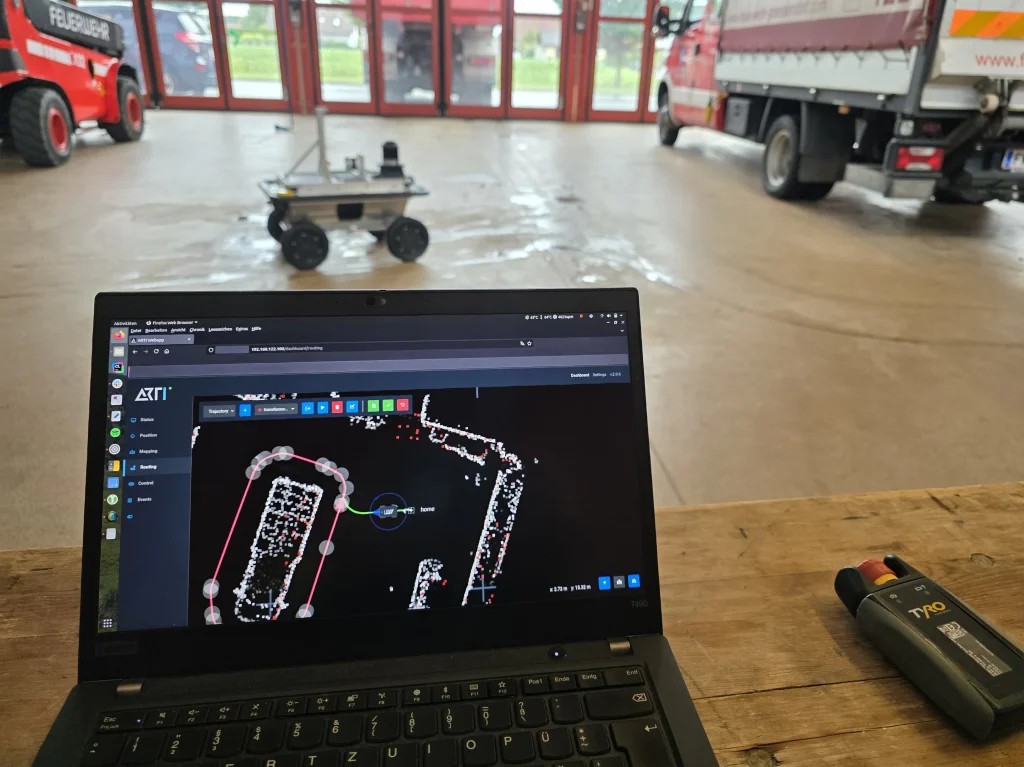
Using onboard sensors and mapping technology, the system generated a representation of the object’s perimeter and transformed that information into an executable measurement path. The generated trajectory maintained a predefined offset distance from the detected contour, allowing measurements to be performed consistently around the entire structure.
This may sound straightforward, but in practice it requires continuous interaction between perception, path planning, and motion control. Small irregularities in the detected contour can significantly influence the generated path, making robust geometry processing and trajectory generation essential.
The successful implementation of this workflow demonstrated how perception-driven navigation can enable entirely new classes of autonomous measurement applications.
Real-World Testing
As with most robotics projects, real-world conditions proved just as important as the software architecture itself.
Before carrying out the final validation in the customer’s operational environment, ARTI conducted extensive real-world testing in a representative mock-up scenario. To recreate the key challenges of the application, a large emergency vehicle was used as a stand-in for the object whose contour needed to be detected and tracked.
This allowed the team to thoroughly validate the complete workflow – from contour detection and trajectory generation to autonomous path execution – under realistic conditions while maintaining the flexibility to quickly iterate and refine the solution.
An additional benefit of this setup is that the corresponding photos and videos can be shared publicly. Details about the customer and the exact application will only be disclosed once the overall project has been fully completed.
The testing environment included various practical constraints that autonomous systems frequently encounter, such as floor-level infrastructure, cables, and obstacles that could influence both path generation and motion execution.
The preliminary tests proved invaluable for validating the robustness of the system and preparing for the final on-site deployment. During the subsequent customer trials, the automatically generated measurement trajectories performed as intended. Particularly encouraging was the smooth trajectory-following behaviour observed during testing. Once the contour had been generated and the measurement path created, the robot was able to complete the autonomous measurement runs reliably while maintaining the intended route around the object.
The successful test campaign confirmed that the combination of automated contour recognition, trajectory generation, and autonomous navigation can reliably support measurement workflows around large static objects with minimal operator effort.
Key Takeaways
This project reinforced several important lessons:
- Autonomous measurements require more than accurate navigation.
- Automatic contour detection can be the key enabling technology for perimeter-based workflows.
- Maintaining a constant distance to complex geometries demands tight integration between sensing, planning, and control.
- Ease of use is critical for successful adoption of robotics solutions.
- Flexible software architectures make it possible to transfer solutions to a wide range of future applications.
Most importantly, the project showed how a relatively simple operator workflow can hide significant technical complexity behind the scenes. By combining automated perception, path generation, and autonomous execution, ARTI’s software transformed a challenging measurement task into a repeatable and easy-to-use process.
While the original application focused on a specific measurement scenario, the underlying technology is broadly applicable wherever autonomous inspections, measurements, or data collection must be carried out at a defined distance around large static objects – demonstrating the versatility of modern perception-driven robotics.